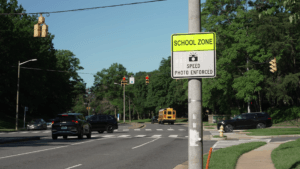


Los Angeles speed cameras are now operational at a large swath of intersections across the city, but it will still be several weeks before speeding drivers are ticketed.
On Monday, the Los Angeles Department of Transportation officially flipped the switch on the city’s speed camera network—which will be the largest in the state when fully up and running.
There are 125 speed camera locations within Los Angeles city limits, as required by state law.
As of Tuesday, only about one-fifth are currently taking photos, but the rest should be operational by the end of the year, officials said.
Until then, the cameras that are capturing images of speeding drivers are doing so as part of an early grace period, which is set to expire after 60 days. That means many of these cameras will begin ticketing drivers before the calendar year ends.
The remaining cameras are all under construction at this time, but when they are operating that same 60-day grace period will go into place before citations start.
How do Los Angeles’ speed cameras work?
The speed cameras are located at intersections that have previously been identified as high-incident intersections where crashes have occurred and where seniors, children and vulnerable people live and work.
When a driver passes through the intersection, depending on their speed, the automated camera will grab a photo of the vehicle and the license plate. The camera is only triggered when it’s determined that the vehicle is going more than 10 mph over the posted speed limit.
That gives a little bit of wiggle room for those just slightly exceeding the speed limit, but not much.
How much are the speeding tickets?
Fines are also based on just how brazenly the speed limit was ignored.
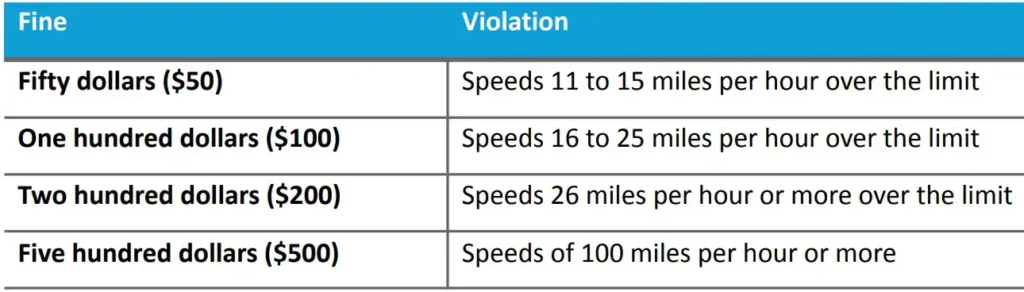
For someone traveling 11 mph over the speed limit, a warning will be issued first. If it happens again, the first citation will likely be around $50 but they scale from there.
Someone driving 16 to 25 miles over the limit can expect a $100 fine; a $200 fine will be issued for anything over that. Someone caught driving at over 100 mph, regardless of the posted speed limit, could receive a fine of $500.
Any money collected through the program is required to be directed toward projects that promote street safety, including infrastructure to support biking and pedestrian improvements.
Where are the speed cameras located?
The camera network is spread out relatively evenly across Los Angeles’ city council districts, with each district having eight or nine cameras each.
Below is a breakdown of the speed camera network based off city council districts, including where the cameras are currently up and running.
| District | Councilmember | Active / total | Area |
|---|---|---|---|
| 1 | Eunisses Hernandez | 2 / 8 | Northeast LA (Highland Park, Cypress Park) plus Westlake and Pico-Union |
| 2 | Adrin Nazarian | 3 / 8 | East-central San Fernando Valley (North Hollywood, Valley Village, Valley Glen, Studio City, Sun Valley) |
| 3 | Bob Blumenfield | 0 / 8 | West San Fernando Valley (Canoga Park, Reseda, Winnetka, Tarzana, Woodland Hills) |
| 4 | Nithya Raman | 3 / 9 | Hollywood Hills and Los Feliz, plus Valley areas such as Sherman Oaks, Encino and Lake Balboa |
| 5 | Katy Yaroslavsky | 6 / 8 | Central Westside and Mid-City (Fairfax, Beverly Grove, Westwood, Pico-Robertson, Palms) |
| 6 | Imelda Padilla | 1 / 9 | Central/east San Fernando Valley (Van Nuys, Panorama City, North Hills, Arleta) |
| 7 | Monica Rodriguez | 2 / 8 | Northeast San Fernando Valley (Pacoima, Sylmar, Sunland-Tujunga) |
| 8 | Marqueece Harris-Dawson | 2 / 9 | Western South LA (Baldwin Hills, Crenshaw, Florence corridor) |
| 9 | Curren D. Price Jr. | 0 / 9 | South/Central-South LA (Vermont, Figueroa, Slauson, Central Ave corridors) |
| 10 | Heather Hutt | 1 / 9 | Mid-City and Koreatown area (Mid-Wilshire, West Adams, Crenshaw/La Brea corridors) |
| 11 | Traci Park | 2 / 8 | Coastal Westside (Brentwood, Mar Vista, Venice, Westchester, Pacific Palisades) |
| 12 | John Lee | 2 / 8 | Northwest San Fernando Valley (Northridge, Granada Hills, Porter Ranch, West Hills) |
| 13 | Hugo Soto-Martínez | 1 / 8 | East Hollywood, Echo Park, Silver Lake, Atwater Village area |
| 14 | Ysabel J. Jurado | 0 / 8 | Downtown, Boyle Heights, El Sereno and parts of northeast LA |
| 15 | Tim McOsker | 1 / 8 | Harbor area (San Pedro, Wilmington, Harbor Gateway) plus Watts |
An interactive map of the speed camera locations, as well as a schedule of fines, can be found on the LA DOT website.*
- (That page has been inaccessible for the better part of Tuesday for reasons that aren’t immediately clear)
Why does Los Angeles need speed cameras?
The greater Los Angeles area is dealing with an epidemic of sorts in the form of “street violence.”
For three consecutive years in Los Angeles, traffic fatalities outpaced homicides citywide. In 2023, a decade-high of 336 people died in crashes in the city while homicides totaled 327 that year. The homicide total continued to drop in consecutive years in 2024 and 2025, while deadly crashes continued to claim a higher number of lives.
Pedestrians, in particular, have been the biggest victims of vehicle violence. That same year in 2023, 185 pedestrians were killed in traffic collisions, another modern record. There have been more than 150 pedestrian deaths on L.A. streets each of the last four years.
The rise of pedestrian deaths has been described by advocates and city leaders as a public health crisis.
By many metrics, it’s never been more dangerous to be a pedestrian. Vehicles are decidedly larger than they were decades earlier, and streets are often engineered to reduce traffic and keep vehicles moving rather than being designed with safety in mind.
Vehicles are big. People are impatient. Drivers go fast. And pedestrians, as well as passengers, pay for it.

And that doesn’t even begin to touch on the rise of smart devices or driving while impaired.
Over the past decade as a reporter in Southern California, I’ve reported on several high-profile crashes that have stolen lives and devastated communities.
And, despite Los Angeles leaders previously stating they wanted to eliminate traffic deaths by 2025, things have gotten statistically worse.
Verra Mobility, the company contracted to install the speed cameras, has reported significant drops in speeding incidents, as high as 94%, in neighborhoods where its cameras can be found. San Francisco’s own program saw a 50% decline in traffic fatalities in the past year and an 80% decline in speeding after one year of use.
If you don’t want to take the word of the company getting paid to install cameras at face value, which is fair, there is also ample evidence from independent studies that largely back up those claims.
Still, concerns about the proliferation of cameras operated by technology companies on our nation’s streets are warranted. Privacy advocates have raised flags about the near-constant surveillance the average American endures simply by existing in the modern age.
These cameras don’t offer much respite from that, although they will likely save lives. It’s also an important distinction that the cameras being used for speed enforcement aren’t the same as other general security cameras that law enforcement agencies can tap into, namely FLOCK.
Speed cameras are the most logical next step to prevent unnecessary deaths if regular enforcement has failed or is otherwise not attempted.
If you’re picking your poison between privacy and the safety of your neighbors, no one is going to be fully satisfied with the results. But transit advocates and transportation officials say the tradeoff, ultimately, is worth making.
“The deployment of this program will increase accountability for excessive and chronic speeding, and help people make better choices about their driving,” LA DOT says. “The goal is safer streets, more lives saved, and fewer severe injuries. Even one life lost is one too many.”
For more stories like this, follow Rail and Runway on Instagram and Facebook.